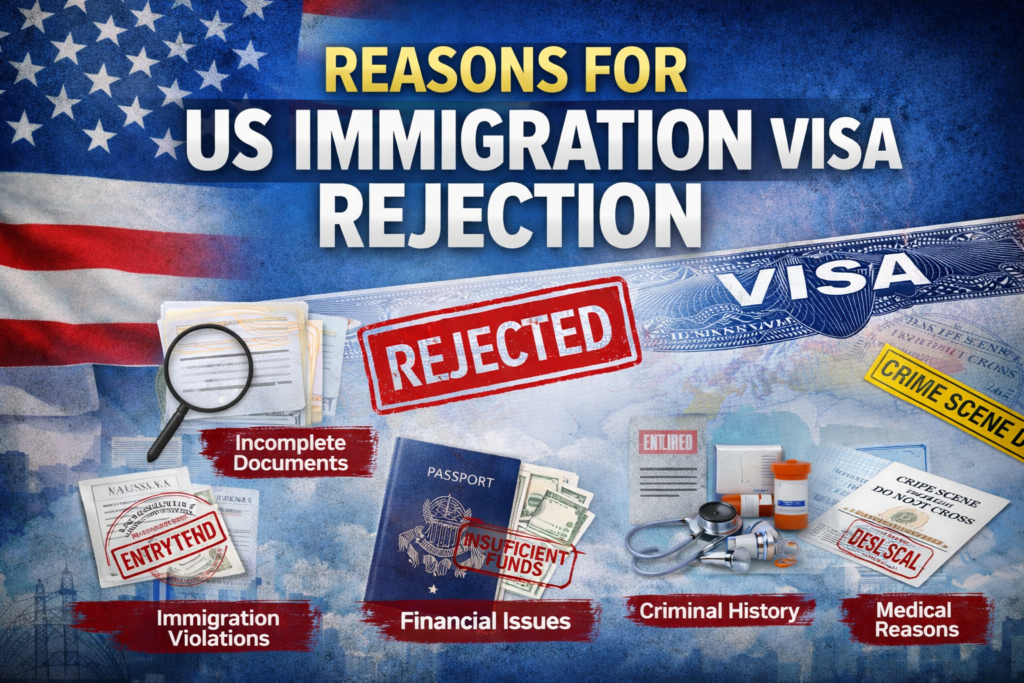
The United States immigration system is one of the most complex and strictly regulated in the world. Every year, thousands of applicants apply for US immigrant visas to reunite with family members, pursue employment opportunities, or permanently settle in the country. However, a significant number of applications are rejected or refused due to various legal, procedural, and eligibility-related reasons.
Understanding the common reasons for US immigration visa rejection is crucial for applicants to avoid costly mistakes, long delays, and permanent inadmissibility. This guide explains the most frequent causes of rejection and how applicants can reduce their risk.
Incomplete or Incorrect Documentation
One of the most common reasons for US immigration visa rejection is missing, inaccurate, or inconsistent documentation.
US immigration authorities require extensive paperwork, including:
- Birth certificates
- Marriage or divorce records
- Police clearance certificates
- Financial documents
- Employment letters
- Affidavits of support
If documents are missing, outdated, poorly translated, or contain conflicting information, the visa officer may refuse the application under administrative or legal grounds.
How to avoid it:
Ensure all documents are complete, accurate, properly translated, and consistent across forms and supporting evidence.
Failure to Meet Financial Requirements (Public Charge Rule)
US immigration law requires most immigrant visa applicants to prove they will not become a public charge, meaning they are unlikely to depend on government assistance.
For family-based visas, sponsors must submit Form I-864 (Affidavit of Support) and demonstrate sufficient income or assets. If the sponsor’s income does not meet the required threshold or financial documents are weak, the visa may be rejected.
Common issues include:
- Sponsor income below the poverty guideline
- Inconsistent tax returns
- Unverifiable employment
How to avoid it:
Use a financially qualified sponsor, submit complete tax records, and provide strong evidence of income or assets.
Criminal History or Security Concerns
Applicants with criminal records or security-related concerns face a high risk of visa rejection. Crimes involving fraud, violence, drugs, or moral turpitude are particularly serious under US immigration law.
Even minor offenses or old cases can lead to refusal if not properly disclosed.
Additionally, applications may be rejected due to:
- National security concerns
- Association with banned organization
- Incomplete background checks
How to avoid it:
Always disclose past incidents honestly and seek legal guidance if there is any criminal or security-related history.
Fraud or Misrepresentation
Providing false information, fake documents, or misleading statements is one of the most serious reasons for US immigration visa rejection.
Examples include:
- Fake marriage certificates
- False employment claims
- Concealing prior visa refusals
- Incorrect family relationships
A finding of fraud or misrepresentation can result in permanent inadmissibility, making it extremely difficult to obtain a US visa in the future.
How to avoid it:
Never submit false documents or information. Honesty and transparency are critical throughout the application process.
Failure to Prove a Genuine Relationship (Family-Based Visas)
For family-sponsored immigrant visas, applicants must prove that the relationship with the petitioner is genuine and legally valid.
Visas are often rejected if:
- Marriage appears to be entered solely for immigration purposes
- Insufficient evidence of a long-term relationship
- Inconsistent interview answers
US authorities closely scrutinize spousal and fiancé-based visas to prevent marriage fraud.
How to avoid it:
Provide strong evidence such as photos, communication records, joint financial documents, and consistent interview responses.
Employment-Based Eligibility Issues
Employment-based immigrant visas require applicants to meet specific qualifications, including education, work experience, and job offer validity.
Common rejection reasons include:
- Employer not properly registered or approved
- Job offer does not meet visa category requirements
- Applicant lacks required skills or experience
- Labor certification (PERM) issues
How to avoid it:
Ensure the employer and job offer fully comply with US immigration regulations and submit detailed professional documentation.
Medical Inadmissibility
All immigrant visa applicants must undergo a US-approved medical examination. Visas may be rejected if the applicant is found to have:
- Certain communicable diseases
- Missing required vaccinations
- Serious medical conditions posing public health risks
In some cases, waivers may be available, but not all conditions are eligible.
How to avoid it:
Complete the medical exam with an authorized physician and follow vaccination and health requirements carefully.
Previous Immigration Violations
Applicants with a history of overstaying visas, illegal entry, or deportation may face automatic rejection due to inadmissibility bars.
Violations include:
- Overstaying a US visa
- Working without authorizetion
- Prior removal or deportation orders
These issues can trigger 3-year, 10-year, or permanent bans from re-entering the US.
How to avoid it:
Disclose all prior immigration history accurately and explore waiver options if applicable.
Poor Visa Interview Performance
The visa interview plays a crucial role in the final decision. Rejections may occur if applicants:
- Provide inconsistent or unclear answers
- Appear unprepared or nervous
- Fail to explain their case confidently
Visa officers assess credibility, intent, and eligibility during the interview.
How to avoid it:
Prepare thoroughly, understand your application, and answer questions honestly and clearly.
Administrative Processing and Background Delays
Some visa applications are refused temporarily under administrative processing, which may later result in rejection if additional checks fail.
Reasons include:
- Extended security screening
- Missing verification
- Policy changes or visa suspensions
How to avoid it:
Submit a complete application and remain responsive to embassy requests.
Overview
US immigration visa rejection can occur for many reasons, ranging from documentation errors to serious legal inadmissibility issues. Most refusals are preventable with proper preparation, accurate information, and expert guidance.
Applicants who understand the rules, submit strong documentation, and approach the process honestly significantly improve their chances of success. Given the complexity of US immigration law, seeking professional advice before applying can help avoid rejection and long-term consequences.
Watch full video for getting for information